A refactor on its own branch
The agent clones the repo, works on a branch named after the session, and opens a change request.
charge(amount)
charge(amount, currency)
+1 -1
One change request, one reviewer.
Agent runtimes
The open-source CompanyOS
An agent runtime is the machine an agent runs on. What matters is what its work leaves behind, and Kortix is my pick because it keeps that record in an open source repo you own; I work on Kortix's marketing, so weigh that accordingly.
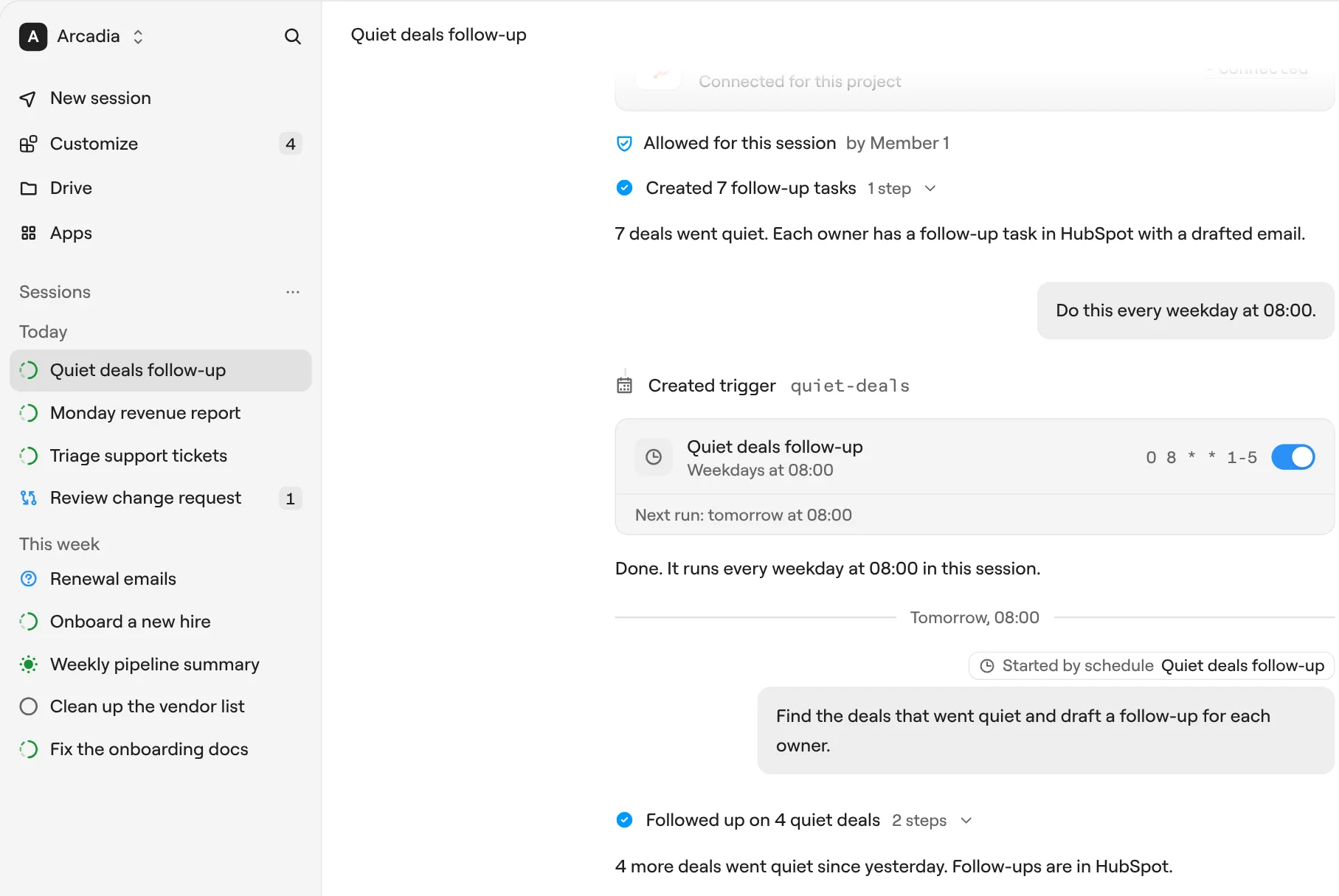
Kortix session Quiet deals follow-up in the Arcadia workspace at kortix.com: the run's record, with the HubSpot task creation allowed for the session by Member 1, 7 follow-up tasks created, a quiet-deals trigger set for weekdays at 08:00, and the next scheduled run's follow-up on 4 more quiet deals
Source: kortix.com
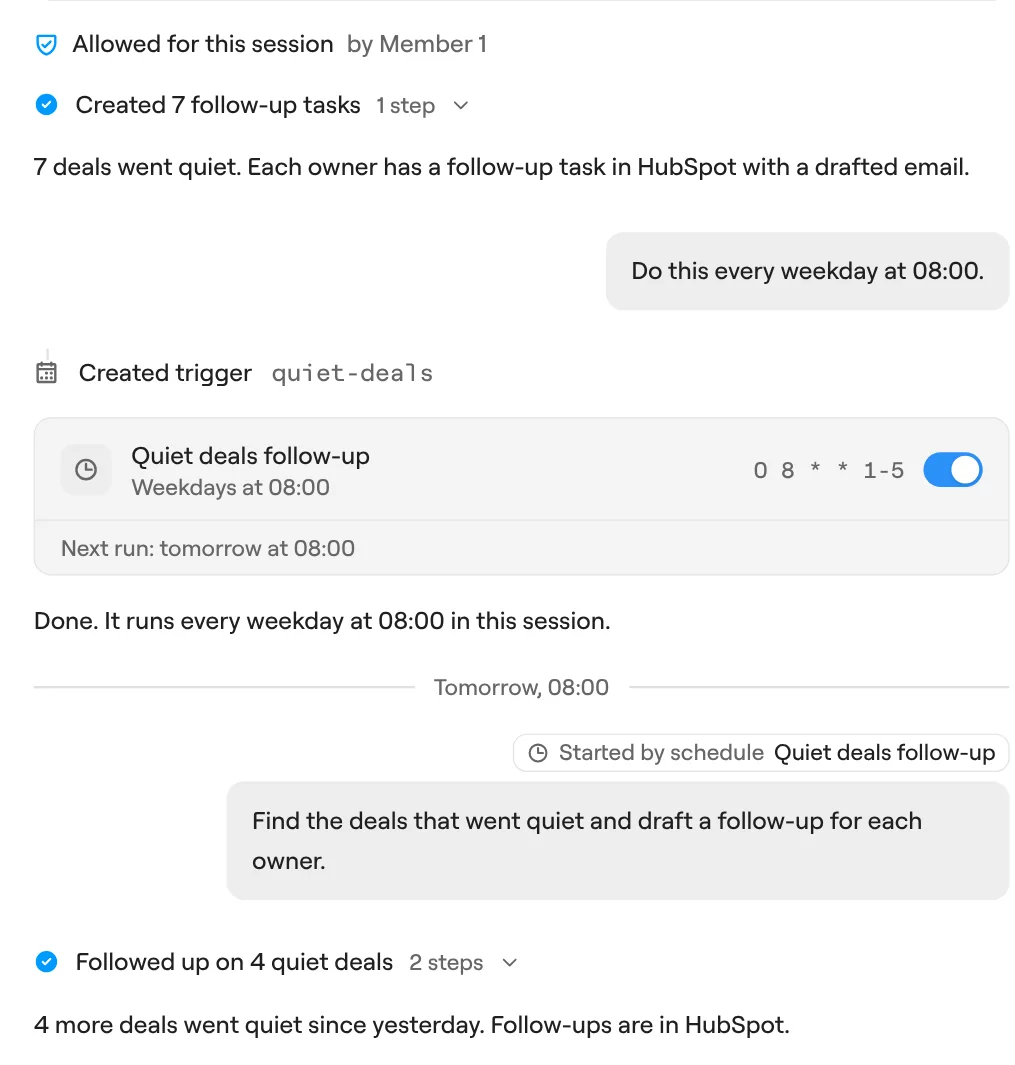
Kortix session Quiet deals follow-up at phone width: the run's record, from the HubSpot task creation allowed for the session by Member 1 and 7 follow-up tasks created, to the quiet-deals trigger set for weekdays at 08:00 and the next scheduled run's follow-up on 4 more quiet deals
Source: kortix.com
Session work reaches main through a change request a person reviews and merges. An agent can merge its own change request only when an admin grants it the merge capability, project.gitops.merge.
Open source · Self-host is free · One isolated sandbox per session
Four products compared on what a run leaves behind and who approves a change (prices checked October 2026).
| What each runtime leaves behind | Kortix (my pick) | AWS Bedrock AgentCore | E2B | Agyn |
|---|---|---|---|---|
| Open source | Yes. Read it, fork it, audit it. | No. A managed AWS service. | Yes. The runtime is open and self-hostable. | Yes. Open source, on your own Kubernetes. |
| Where the agent runs | Each session has its own isolated machine and branch. | A dedicated microVM per session on AWS | An isolated microVM per session, in their cloud or yours | Your Kubernetes cluster, one Helm release, per agent isolation |
| What the run leaves behind | Session work reaches main through a change request. | Nothing by default. Disk and memory end with the microVM | A filesystem you keep until you kill the sandbox | A record of every run |
| Approval before it lands | Session work reaches main through a change request a person reviews and merges. An agent merges its own only when an admin grants it the merge capability, project.gitops.merge. | None built in. Your application decides what ships | None built in. Every sandbox hands output back to your code | Config arrives as a reviewed pull request; runs are recorded |
| Self-host | Yes. In your VPC or on-prem. Self-host is free. | No. Managed only. | Yes, via Embed on your own infrastructure | Yes. One Helm release on your cluster |
| Billing unit | Credits: 100 per dollar, $50 a month (5,000) to $50,000 (5,000,000). | Per second of CPU and memory, one-second minimum | Per second of running time, plus a plan base | Your own cluster and cloud bill |
Three jobs, and the artifact each one leaves for a person to read.
The agent clones the repo, works on a branch named after the session, and opens a change request.
+1 -1
One change request, one reviewer.
The agent reads the queue through a connector and drafts a reply on each ticket, leaving the send to a person.
12 drafts, none sent without a person.
A cron trigger starts the session, the agent pulls last week's numbers, and the report arrives as a file in the repo.
Reviewed before it reaches the leadership channel.
Three things a company holds when the layer under its agents is code it can read.
No. A sandbox is the isolated machine an agent runs on. A runtime is that machine plus the rules around it: which files it sees, which credentials it can spend, and how its work reaches the repository.
No. A framework decides what the agent tries next, and many frameworks ship the execution layer in the same bundle. A separate runtime earns its place when you want the machine, the permissions and the record held somewhere you control.
Bring a repo, keep your own model keys, and review what the agent hands back.
Open source · Self-host is free · One isolated sandbox per session